Your Cart is Empty





















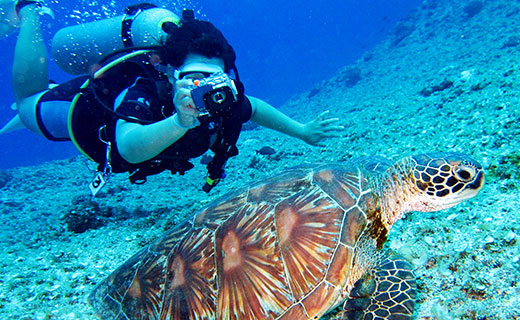

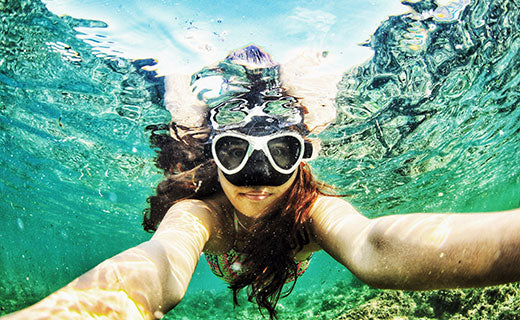

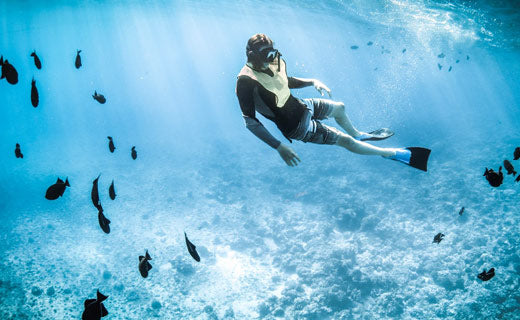























The best camera for diving depends on how underwater content is captured. Some divers prefer a simple, tough action camera that can move from boat to reef to dinner without changing setups. Others lean toward a dedicated underwater compact or a smartphone housing that keeps an existing mobile workflow intact.
Below are the best diving camera options, ranked for real-world dive-trip content creation, with key features, pros, and cons.
|
Camera |
Waterproof depth (no case) |
Low-light video mode |
Front/flip screen |
Highlight editing |
Built for |
|
Insta360 Ace Pro 2 |
12m / 39ft |
PureVideo + Active HDR (4K60fps) |
2.5" flip touchscreen |
AI Highlights Assistant + one-tap edit, done in-camera |
Diving plus everyday/travel content on one camera |
|
SeaLife Micro 3.0 |
61m / 200ft (sealed body)* |
Not specified by SeaLife |
Fixed 2.4" screen, no flip |
Not specified |
Dedicated underwater shooting only |
|
OM System Tough TG-7 |
15m / 49ft |
Not specified by OM System |
Fixed 3" screen, no flip |
Not specified |
Rugged travel compact, macro/stills |
|
DiveVolk SeaTouch 4 Max Plus |
60m / 200ft (housing)* |
Depends on connected phone's camera |
Uses the phone's own screen through the housing |
Depends on phone's own apps |
Smartphone-based underwater touchscreen control |
|
GoPro HERO13 Black |
10m / 33ft |
No dedicated low-light video mode (night effects are for stills/timelapse only) |
Rear touchscreen only, no front/flip screen |
Auto-edit via Quik app (phone-based) |
Action sports with a broad accessory ecosystem |
|
DJI Osmo Action 5 Pro |
20m / 66ft |
SuperNight (up to 4K) |
Dual OLED screens (front 1.46" + rear 2.5") |
Auto-edit via DJI Mimo / LightCut app (phone-based) |
Action sports and underwater wide shots |
Best For: Divers who want a single conventional single-lens action camera that produces high-quality underwater video, stays flexible in low light, and also covers the rest of a trip above the surface.
The Insta360 Ace Pro 2 is Insta360’s flagship 8K action camera, co-engineered with Leica, and positioned for dive-trip content creation that needs to look good underwater and still feel natural for everyday travel shooting. It combines a 1/1.3" sensor with an F2.6 Leica SUMMARIT lens, plus a dual-chip system (a dedicated imaging chip and a 5nm AI chip) aimed at improving processing speed and low-light clarity for murkier water, shaded reef structure, and later-in-the-day dives.
For divers, the most practical advantage is straightforward: it’s waterproof to 12m/39ft without a case, so it can head straight into snorkeling, freediving, pool sessions, and many shallow scuba scenarios without extra setup. When deeper underwater coverage is needed, Insta360 offers an optional Dive Case and Floating Hand Grip bundle, allowing the kit to scale with the dive plan instead of forcing a single fixed configuration.

1/1.3" sensor with F2.6 Leica SUMMARIT lens, co-engineered with Leica
8K video at 30fps (7680×4320) and 4K video at up to 120fps
4K60fps Active HDR for challenging contrast near the surface
4K60fps PureVideo low-light mode for dim or green water conditions
Dual-chip system (imaging chip + 5nm AI chip) for noise reduction and faster processing
Waterproof to 12m/39ft without a case, with optional Dive Case for deeper dives
2.5" flip touchscreen (329 PPI, 900 nits) for easy framing on boats and in bright sun
FlowState stabilization with 360° Horizon Lock for smoother fin-kick and swim shots
Built-in Wind Guard for clearer audio when topside on boats or beaches
AI Highlights Assistant, one-tap auto editing, and AI Selfie Stick Eraser
Gesture control and Voice Control 2.0 designed to work with gloves and helmets
50MP photos (8192×6144)
1800mAh battery with up to 180 minutes runtime and full charge in 47 minutes
microSD support up to 1TB (no built-in storage)
Strong underwater and travel versatility as a single-lens action camera for the whole trip
Excellent low-light performance for shaded reefs and late-day dives, backed by the dual-chip design
Ready for the water immediately at 12m/39ft without a case, with a clear upgrade path via the optional Dive Case
Flip screen makes it easier to compose selfie narration, gear checks, and surface intervals
Supports a microSD card up to 1TB (no built-in storage)
SeaLife’s Micro line is a familiar pick among divers who want underwater simplicity first. The Micro 3.0 is designed specifically for underwater use and is commonly paired with SeaLife lighting accessories, which can be particularly useful for bringing back color and contrast as depth increases.
Dedicated underwater compact camera form factor
Designed to be used with underwater lighting and trays
Simple controls geared toward divers
Purpose-built underwater shooting workflow
Diver-friendly handling and menu approach
Works well as part of a SeaLife lighting and accessories ecosystem
Good option for divers who do not want an action cam workflow
Less versatile for general travel use compared with a typical action camera
Accessory costs can add up if you build out a full light and tray kit

The OM System Tough TG-7 remains a long-running favorite for rugged travel because it packs easily, operates simply, and tends to suit close-up details like coral textures and smaller marine life when paired with solid technique and the right add-ons.
Rugged compact camera design for travel and outdoors
Strong reputation for close-up and macro-friendly shooting
Simple physical controls that are easy to learn
Great “grab-and-go” feel for dive travel
Good for detail shots and casual underwater photography
Compact and easy to pack with other dive gear
For serious depth and extended scuba use, many divers prefer pairing it with dedicated underwater accessories
Video-focused creators may prefer an action camera workflow
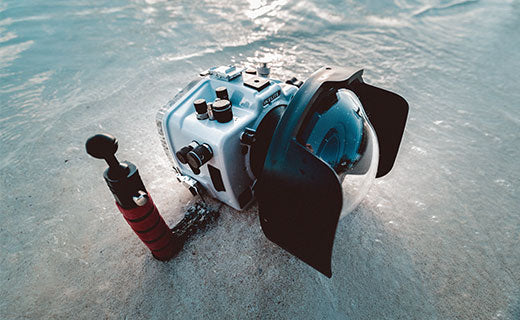
Smartphone housings are often most appealing when the goal is to keep a phone’s camera app, familiar editing tools, and sharing pipeline. DiveVolk’s SeaTouch line centers on maintaining a phone-first experience underwater, including touchscreen-style control through the housing.
Smartphone housing concept for underwater filming and photos
Built around using your phone as the primary camera and interface
Aims to preserve a touchscreen-style experience
Lets you keep an all-phone workflow for capture and sharing
Convenient for casual underwater clips and travel documentation
Often appealing to divers who already like their phone’s image processing
Your results depend heavily on your specific phone model and settings
A bulkier setup than a standalone action camera for mixed above-water activities
GoPro continues to be a common reference point for action footage, supported by a huge accessory market and abundant third-party mounting options for dive masks, trays, handles, and lights.
Action camera platform with extensive accessory support
Wide-angle video capture for immersive reef shots
Commonly used with dive mounts, trays, and lights
Massive accessory ecosystem and widespread community support
Easy to find compatible mounts for nearly any dive setup
Strong choice for wide-angle, point-and-shoot underwater clips
Many divers will want to add filters or lights for best color at depth
Accessory-heavy builds can become complex for minimalist travelers
DJI’s Osmo Action series is a frequent choice for action sports and can translate well to underwater wide shots, particularly for divers who prefer DJI’s stabilization look and the brand’s accessory approach.
Action camera designed for high-motion capture
Adventure-focused bundle with mounts and add-ons
Wide-angle capture style suited to reef scenes and group shots
Good option for divers who also shoot biking, hiking, and other action sports
Strong ecosystem of mounts for travel and helmets
Capable tool for quick, social-ready clips
Low-light underwater performance can be a deciding factor depending on your dive conditions
Some divers prefer a flip-screen style workflow for self-filming
When selecting the best camera for diving, consider:
Dive Style: For an all-in-one travel and dive solution, a single-lens action camera like Insta360 Ace Pro 2 can cover underwater footage and the rest of a trip. For dedicated underwater shooting, a dive-first compact can be a better fit.
Typical Depth: If most use is snorkeling or shallow diving, a camera that’s waterproof to 12m/39ft without a case can keep the setup simple. For deeper dives, a housing or dedicated dive case becomes part of the plan.
Low-Light Conditions: Murky water, shaded swim-throughs, and late-day dives demand stronger low-light performance. Sensor size, lens brightness, and processing are typically the deciding factors.
Editing Workflow: For fast highlights, strong stabilization and automated editing tools help speed output. For manual control, the best results usually come from matching the system to existing shooting habits.
Total System Cost: Trays, filters, lights, spare batteries, and housings can change the real price quickly. A camera choice should align with the long-term kit plan, not only the base camera cost.
A good diving camera is easy to operate underwater, produces stable wide-angle footage, and holds up in low light and underwater color loss. Practical factors matter as well, including whether the camera is waterproof without a case, how easily it can be mounted to a tray or handle, and whether lights or filters can be added over time as skills improve. Cameras like the Insta360 Ace Pro 2, which is waterproof to 12m/39ft straight out of the box and includes dedicated low-light modes like PureVideo and Active HDR, are built around these priorities, with an optional Dive Case available for deeper scuba use.
The best diving camera is the one that matches depth, lighting conditions, and travel needs. Some options excel as dedicated underwater systems, while others are built to function as a single camera for an entire trip. For divers looking for a conventional single-lens action camera that’s designed for dive-trip content creation, works underwater and above the surface, and delivers strong low-light performance with Leica co-engineering, the Insta360 Ace Pro 2 stands out as the most well-rounded pick. With 8K at 30fps, 4K up to 120fps, 4K60fps Active HDR, 4K60fps PureVideo, and waterproofing to 12m/39ft without a case, it remains a dependable choice for capturing the moments divers actually come to see.
ABOUT THE AUTHOR
Aleksandra Djurdjevic
Senior Content Creator
Aleksandra Djurdjevic is a senior writer and editor, covering surf, kayak and various watersports activities. She has previously worked as ESL teacher for English Tochka. Aleksandra graduated from the Comparative Literature department at the Faculty of Philosophy in Serbia. Aleksandra’s love for the ocean / rivers, getting out waves, season after season, seeking epic adventures across the globe helps her continue to be a top expert at CSG.


